
In an era of digital transformation, smart glass technology emerges as a revolutionary addition to banking and finance offices. This article explores how smart glass enhances customer experience, bolsters security, and boosts efficiency.
We will delve into its technical specifics, practical applications smart glass, and potential future prospects within the banking sector. With its promise of innovation, smart glass holds the potential to redefine the traditional banking environment, offering a new dimension of convenience and freedom.

Understanding Smart Glass Technology
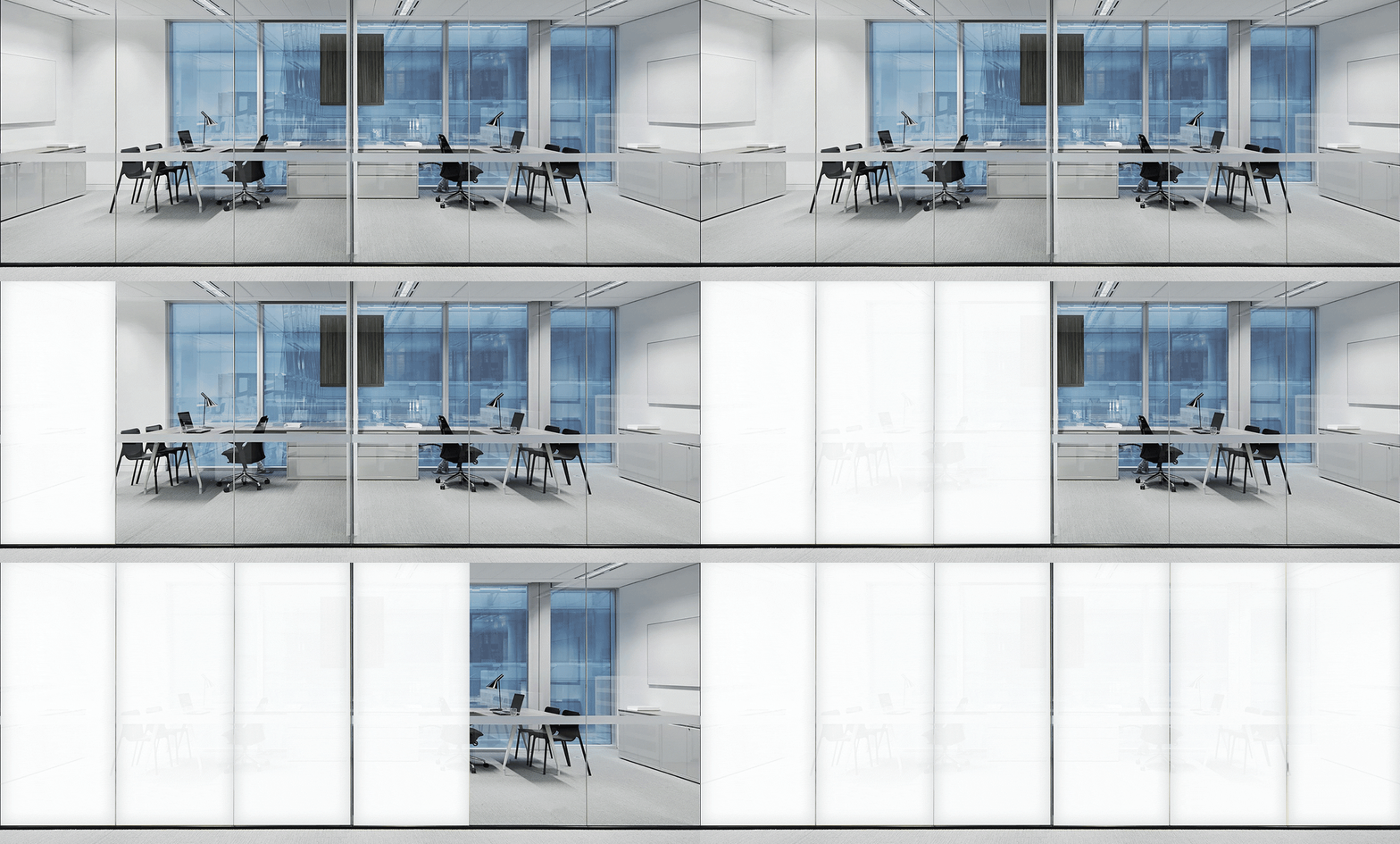
The first step to comprehending the application of smart glass in banking and finance offices is to unravel the technology that underpins it. Essentially, smart glass is a state-of-the-art technology that employs the use of electronically controlled light modulation to switch between transparency and opacity Chiefway smart glass.
This transformative technology is driven by a scientific phenomenon known as electrochromism. When a specific voltage is applied, electrochromic materials can change their optical properties, allowing for a seamless shift between transparency and opacity. This intricate process is facilitated by five superimposed layers: two conductors, two electrochromic layers, and an ion conductor in the middle.
Smart glass is not just a technological marvel, but also a tool for freedom, offering unprecedented control over privacy and light. Its integration in banking and finance offices can foster a more flexible and dynamic workspace, contributing to increased productivity and security. It offers a liberating solution to traditional limitations, like fixed partitions, by providing the ability to instantly customize privacy settings. This fusion of technology and freedom is what makes smart glass a revolutionary addition to banking and finance offices.
Enhancing Customer Experience With Smart Glass
Leveraging smart glass technology, banking and finance offices can significantly enhance customer experience by creating a secure, flexible, and private environment. The integration of this technology into these offices offers a blend of convenience and privacy, two elements highly valued in the banking and finance sector.
From a technical perspective, smart glass operates by applying a small electrical charge that aligns particles in the glass to control light transmission levels. Transitioning from transparent to opaque, it provides instant privacy at the touch of a button. Thus, it ensures confidentiality during sensitive financial discussions, thereby bolstering customer trust.
Furthermore, smart glass offers a modern, sleek aesthetic that enhances the overall ambience of banking halls and finance offices. With its ability to control glare and heat, it contributes to a comfortable environment, improving the customer’s overall experience.
Moreover, since smart glass eliminates the need for curtains or blinds, it promotes a sense of openness and freedom, enhancing the overall banking experience. By integrating this technology, financial institutions can offer an innovative, secure, and private space that caters to the evolving expectations of modern customers.
Smart Glass and Office Security
In the age of heightened cybersecurity risks, smart glass technology presents a compelling case for physical security in banking and finance offices. Beyond their aesthetic appeal and energy efficiency, they provide a robust security layer that can significantly enhance the safety standards of these establishments.
Smart glass is equipped with electronic controls that allow users to instantly switch between transparency and opacity. This feature can be leveraged to protect sensitive information from prying eyes, thereby mitigating risks associated with data breaches. In addition, smart glass can be programmed to turn opaque in response to specific triggers, such as a security breach, providing an immediate physical barrier.
Moreover, smart glass is highly durable and resistant to breakage, thereby offering protection against forced entry. Furthermore, it can be integrated into a comprehensive security system, enabling remote monitoring and control.
The adoption of smart glass technology in banking and finance offices can thus serve as a potent measure to fortify physical security, complementing existing cybersecurity measures. In this way, smart glass can help create an environment where freedom from fear of physical and data security breaches is possible.
Efficiency Gains From Smart Glass
Beyond bolstering security, smart glass also contributes to operational efficiency in banking and finance offices. This innovative technology aids in energy efficiency by dynamically controlling light and heat transmission, reducing the need for artificial lighting and air conditioning. This not only lowers energy consumption but also cuts down on costs.
Moreover, smart glass enhances productivity by creating adaptable environments tailored to specific tasks or times of day. For instance, it can be adjusted for optimal light conditions during detailed work or made opaque for privacy during sensitive meetings. This adaptability eliminates the need for blinds or curtains and reduces time wasted on managing physical barriers.
Furthermore, smart glass integrates seamlessly with modern office automation systems. It can be programmed to adjust its opacity or light transmission based on predefined schedules or triggered by sensors such as occupancy or daylight sensors. This automated control frees staff from mundane tasks and allows them to focus on core business activities.
Future Prospects: Smart Glass in Banking
With the industry’s growing interest in advanced technology, banking’s future with smart glass holds promising potential for further efficiency and security enhancements. This transformative technology could revolutionize the interface of banking transactions by providing a seamless, user-friendly experience. Interactive teller machines, already gaining popularity, could be further enhanced with smart glass technology, offering a more intuitive and engaging user experience.
Further, smart glass could be utilized in creating private, secure spaces in open-floor plan banking offices, ensuring client data confidentiality and providing an environment conducive to focused work. In an era where data breaches are a significant concern, the application of smart glass technology could provide an additional layer of security, ensuring that sensitive information is visible only to authorized personnel.
The integration of smart glass also holds promise in the realm of energy efficiency. The ability to adjust light transmission properties could significantly reduce energy costs, aligning with the global push towards environmental sustainability. In conclusion, the future of banking could significantly benefit from embracing smart glass technology, driving increased efficiency, enhanced security, and sustainability.
Conclusion
In conclusion, smart glass technology has the potential to significantly transform the banking and finance sector.
By enhancing customer experience, bolstering office security, and promoting efficiency, this innovative technology could redefine the traditional banking office environment.
As it continues to evolve, the adoption of smart glass in banking is poised to become more prevalent, revealing exciting future prospects for the industry.
It is crucial for banks to embrace this technology to remain competitive and relevant in a rapidly advancing digital age.